|
UNDERGROUND VOICES: FICTION
|
|
BENJAMIN WINSHIP
Khathem Bodies. You picture them floating lazily down a river or shoved into the trunk of a car, but its never really like that.
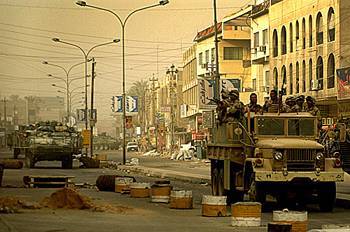
I thought that part of my life was over, a long time ago, when I quit the police force. I was tired of bodies, tired of checking them, tagging them, registering them and reporting on them like they were packages of hamburger. I was tired of the people who caused bodies to turn up, not because they were murderers; because I didn’t feel like going through the rigmarole. It really stiffens up a Monday morning – no pun intended. And yet here I am: working for an NGO in Baghdad, trying to keep my family safe while I work to rebuild this hell of a place. Why would a person who’s sick of bodies come to Baghdad? For one thing they pay you pretty damn well. I’d like to blame it on that. The truth is I gave up control of my life a long time ago. I blame God for most of my problems now. You can roll your eyes at me all you want, but next time you see a wealthy wall street executive pulling his hair out because he’s so stressed, remember, he’s in control of his life. I don’t have to do that because I’m not in charge, God is. In fact, I bet you ten to one I’m having a hell of a better time blaming my problems on God than that guy is. I don’t care how many convertibles he has. Next thing you know it’ll be his eyeball on the pavement. Again, I digress. Like I said, I’m working with a company involved in rebuilding the country. That’s the boring part of the job. In war zones, boring tends to be more favorable to exciting. Exciting doesn’t mean a ride on a rollercoaster, it means RPG’s shattering your windows at six in the morning making your sixteen-year-old son wet his bed. It also means people die. Less than I thought. Less than the news makes it seem. I stopped watching the news since I’ve been here. But it still happens. Four people used to work for me. They worked for me until last night at about ten pm. I’d like to say they quit. They wouldn’t do that. The truth is, they got fired. Once again, no pun intended. The people of Mosul made it crystal clear that they didn’t want these four working, or even living anywhere near them. They were gunned down in an intersection. Hundreds of AK bullets shredded their vehicle. This time I don’t have to deal with the paperwork. I just have to take a short trip from Baghdad to Mosul. I am the closest thing any of them has to family here, and the Military needs a positive ID before they can send the bodies back to the states. Bureaucracy never fails to ruin my life. I climb out of bed. It’s too early. The tile’s cold against my feet. No time to shower. I throw on my clothes and glance at my wife. She’s a gently breathing lump of blanket. I hope its not the last time I see her. It can’t be. In the front yard, I’m expecting to find a heavily armored vehicle. Maybe a tank, but a Hummer will do just fine. No such luck; a beat up pick-up truck – right out of every country song I’ve ever heard (the total comes to three). I climb into the passenger’s seat. My eyes are bleary, but this man looks exceptionally dark to be American. “Hi,” I say as jovially as is possible before sunrise. He smiles and nods. This is one of those times. You would say I should have planned this out better. My superiors should have sent an American. But I can blame God. It’s all his fault and I just have to smile and nod back, wondering if this driver speaks any English whatsoever. If not, we are going to have to rely on my Arabic, which is worse than… I’ll spare you. It’s bad. I give in and ask his name in my broken Arabic. It’s Khathem. He’s tall, with facial hair somewhere between a five o’clock shadow and a short beard. It’s tinged with gray. I want to ask him to turn off the horrible Arabic music pouring out of the speakers, but we just met. I don’t want to give a bad impression. I just deal with it. We have a three hour drive ahead of us and – lucky for us – it’s 99 percent desert. I’m not talking about the rolling sand dunes you see on the Discovery Channel, with camels and snakes and stuff. I’m talking about completely flat ground with dirt on it; no living thing for miles. The good news: we can go fast, really fast. The bad news: everybody goes fast. It still takes three hours. I search for the non-existent seat belt for a minute, and we’re off. Before I can yawn twice, we are at the edge of the city and the early morning desert spreads out like widening jaws hungry to greet us. Khathem is bored as fast as I am. He decides it’s get-to-know-you time. He shows me his right index finger. It’s bent at the top knuckle. The tip of his finger just kind of points right instead of straight. He makes a motion of shooting a gun. Then he shows the bullet of the gun hitting his finger. This I can understand. Khathem has been shot in the finger. I know the word for “when” so I say it. He says two words: “Iraq,” then he bangs his fists together, “Iran.” Khathem was shot in the finger during the Iraq-Iran war. I’m beginning to see why he’s in the driver seat. This man must be some kind of veteran. He’s been in sticky situations and gotten out of them. I feel the urge to tell him I’m not so bad myself. I wish I had my old police badge to show him. The only words I can think of in Arabic are “dead soldier.” I wonder if that could ever translate to retired policeman and give it a shot. He furrows his brow. He doesn’t understand but I don’t blame him. It’s too early anyway. Silence ensues. For about an hour, all I hear is static mixed with the eerie whine of an Arabic woman singing her sorrows to the beat of a drum. The vast expanse of dirt, reflecting the sun combines into an almost hypnotizing effect. It’s what I need, what everyone in this country needs: to drift lazily between waking and sleeping, not wondering when you will arrive at the destination you never wanted to go in the first place, and hoping it will never come. But it always does. The sick vacuum in your heart tells you it’s coming. You know the feeling. You ignore it, like the old man, choked to death on tube socks that you just write off as a suicide, like the old, skin-and-bones, blind, legless man holding out his cup, begging for any spare coin and yet you jingle your change in your pocket and walk right by for God knows what reason. You ignore it, but you know it’s there. I know it’s there. A little clump of buildings has appeared on the horizon. I don’t dare to believe it’s really there. I don’t want it to be there. I’ve become quite comfortable in this hot car, thinking of nothing but dirt. Khathem points to it. “Mosul,” he says. It’s only the first time, but I hate it when he’s right. Then he pulls out his gun. I’m not sure how to react so I keep my cool. He’s not pointing it at me or anything. He holds it flat in his palm and reaches it out, for me to look at. It’s nothing special – a standard Browning single action nine millimeter. I notice some curling gold shapes arcing across the top of the grip. Khathem, as if reading my thoughts, points to it. “What does it say?” I ask stupidly in English. “Hadiah,” he says slowly, sounding out the word to make sure I hear it. “Hadiah men Saddam Hussein.” I’ve been here long enough to know two things. The first is that whenever you visit someone’s house or vice versa, there is an exchange of gifts involved. It’s just part of the culture. The second is that the word for gift is “Hadiah.” At the same time, I’m hard pressed to believe that Saddam gave this guy a gift. Not that he didn’t deserve it, it’s just that Saddam Hussein doesn’t seem like the gift giving type to me. “Iraq, Iran.” He says again, banging his fists together. Then he points to himself and makes the motion of firing a gun and saluting. Then he reasserts that he received a special pistol with gold letters saying: A gift from Saddam Hussein. If only I could read Arabic. I go with it for now, no matter how crazy it sounds; I don’t have any reason to think he’s a liar. More to the point, he has no reason to lie to me. I smile and nod, giving him the thumbs up as if I’m in still a teenager in the seventies. Mosul is getting closer now. Like a dirty boil on the clean flat landscape, it stares us down as we approach. The bodies start floating closer to the surface of my consciousness. I can picture the faces, like I last remember seeing them: scared, excited—I stop myself. I’m moving to a bad place, an emotional place. I press the feelings down into my chest. I remember the hundreds of bodies I’ve dealt with before. I focus on the paperwork, the processing and the monotony. It’s not the same. I’m not on that side of it anymore. I’m on this side of the bodies, the real side of them. Small buildings start cluttering the roadside as we drive. The road narrows to a street and fills with traffic. Khathem’s eyes are all over the place. I’m not sure if he’s nervous or what but there is a checkpoint ahead. As we approach, I see that the soldiers are nationals, with the tan uniforms and red pyramid patch. They eye me anxiously. I start fiddling around in my pockets, trying to find my passport as Khathem rolls down the window and gives the soldier a cold stare. They exchange a few words, too fast for me to follow. The next thing I know, the soldier steps back and gives Khathem a salute. Now I know he was telling the truth. We hit the gas and enter the city. It’s more of the same. Blasted buildings rise up above the concrete houses like the skeletons of incinerated giants. Although it’s early morning, droves of people wandered around like shepherdless sheep. I lose myself in the shapeless destitution of it. The car inches along. Small markets along the side of the road sell pants, fruit, spare computer parts and anything else you can think of. Life creeps along, hiding the screeching halt humanity’s spirit has undergone. Traffic builds up along the road. Bad news. Our car slides to a halt. Khathem is visibly nervous. More bad news. When war veterans get nervous, I get nervous. Instantly I know what he is thinking. It happened to them. It could happen to me. Khathem looks at me. “You,” he says, moving his hands up and down, gripping an imaginary steering wheel. “You,” he says again and points to the steering wheel. I get his meaning, but what is he about to do? His door clicks open and he jumps out. I slide over to the driver’s seat and shift it into first. The traffic is heavy and there is not much room to move. Khathem walks to the car in front of us and bangs his pistol against the windshield. He, I assume, explains our situation in a few words. The car pulls to the side of the road and Khathem motions for me to move forward. I press the gas and then lurch along the road. Khathem is already waving his gun at the next car, pulling him aside as well. Once again, I move forward. I have to smile. As odd as the situation is, it seems perfectly normal in Mosul. We follow this scenario for a mile or so down the road, through all the really bad intersections. It must be morning rush hour. It’s bad timing but we both know we need to be home before dark so the earlier we get there the better. Finally we make it to the US military checkpoint. Khathem doesn’t have the pull here that he had before. In fact, he’s treated more like a savage. They don’t even give him eye contact. “Can I see some ID?” the soldier asks me. I show him my passport and the papers explaining the situation. He glances over them briefly. “What about him,” he says nodding to Khathem. “He’s my driver,” I offer. I’m unsure what he wants to hear. “He got ID?” I look at Khathem apologetically. He knows the drill. He shows his ID card, proving he works for us, and the soldier waves us through, pointing us in the direction we need to go. The base is a sharp contrast to the city. Clean streets lined with heavy green and tan vehicles surround us. The buildings are strong and intact, barricaded by walls of concrete and razor wire. Soldiers march to and fro quickly and importantly, stopping only for brief discussions of plans and tactics. My neck tightens. We stop in front of one such building. It’s not marked in any special way but it’s where we were told to go. I get out and head toward the door. Khathem leans against the hood of the car and lights up a cigarette. I wish we could trade places. The saliva is starting to catch in my throat now. My head is pounding from the blood squeezing through the tightness in my neck. A sergeant greets me jovially. I don’t catch his name. I’m not really listening. He leads me down a dingy hallway that ends in a fat metal door. He pulls the handle and cold attacks me. There is a whitish mist as we enter. On either side of me there are fat red and white slabs of meat hanging from curving metal hooks. On the ground are scattered boxes, crusted with frost and filled with hamburger, sausage and chicken. I can’t believe it. There is a crude clearing in the middle of the freezer with the four trays carrying the heavy black body bags. The sergeant looks at his clipboard. He’s antsy to get out of the freezer. I pause for a minute over the first bag. I appreciate that it’s zipped. I wish it could stay like that: an anonymous void of nothingness. I suck the cold into my chest as the man unzips it. Here’s where I finally relax. Not because I’m happy; because this one is the same as all the others, not a person I know, just a body. It’s a pale face with half-slitted lazy eyes, as if she is just about to fall asleep. There’s tiny black punctures all over. I can imagine the bullets exploding into her flesh, but I don’t. I say her name. It doesn’t connect with the face on the table but the man marks it off his clipboard anyway. We move to the next bag. He unzips it. It’s the same thing. Pale face and sleepy eyes. The goatee is crusted with ice and dried blood. I say a name that bounces off the steel walls and disappears into the icy freezer fan. It doesn’t attach to the body either. The pen scribbles the clipboard and we move on. The next body is old. It’s wrinkled and almost blue-green it’s so white. It has a few little black holes right in the cheeks, which makes me cringe. I don’t want to think what that could be like. I tell myself she was in shock. She never felt anything. Then I remember that this isn’t a person, it’s a body. I say the now useless name and there’s another scribble. I’ve got through three and I’m feeling okay. I suddenly realize how cold I am. The zipper hums open and I catch my breath. I try to see a normal face, like the others. Just an old man’s wrinkled white face. It’s not there. There’s a wide, concave mass with rumpled hair. I can guess where a nose would be but it’s in several places. “God!” the sergeant says under his breath. Finally I see it. The work of a rifle butt, or a heavy boot. I wonder if he was still alive when they smashed it in. He couldn’t have been. I see the holes in his wrinkled skin. I say his name slower than the others because I feel bad for him. I know I shouldn’t but there it is. I do. The sergeant scribbles again. Now that my business is over, I realize how irritating that scribbling is. And I’m cold as hell. We retreat silently. When I’m outside I can finally breath normal. Khathem is still smoking. He looks at me questioningly. I don’t know what the hell to tell him. I think he knows that. Somehow we are communicating without words anymore. A tear rolls down his calloused brown cheek. That’s when I start to lose it, but I catch myself. He beats his chest a few times: a formal Arabic lament. I wonder if he has any more cigarettes. I’m not a smoker anymore, but it would be nice right about now. I can’t smile at God anymore, but I sure as hell can’t give him the finger either. Maybe He’s not like us. Maybe he knows what He’s doing. I don’t understand it. Maybe Khathem does. We get in the car and get going. We have to be home before dark or it’ll be us in the meat freezer. I’d like to complain about how long and boring the trip was. But it went by fast. My brain was like a jack-in-the-box. Every few seconds, without warning, the faces would just pop up, distorted and cruel, like they had all been smashed in. I fight to keep them away. I grip the door handle as if it’s my sanity. And before I know it, there’s Baghdad. I never thought I’d be happy to see it. I’m ready to get inside my house and hide for a while. I’m not scared. I’m worn down, like the sandstone rocks that have been subject to windstorms. I’m as thin as a sheet of paper. I need to rebuild what’s left of me. Khathem doesn’t take me home. He stops in front of a small café. There’s a litter of dirty plastic chairs surrounding the entrance. The cool of the evening is just beginning to spread over the calming city streets and it feels good. We sit down. Moments later, a man brings out a water pipe. Khathem takes the hose and pulls the smoke deep into his lungs. The coals bloom a deep rich orange. He lets the smoke out. It drifts out onto the street and dissipates. Then he passes the pipe to me. I take in the smoke, pulling hard to wash away the grime inside me. The tobacco drifts into my head and I can finally let go. Then I exhale the sweet scent. The cloud of smoke drifts across my lap and vanishes in the dust. I pass the pipe back to Khathem. He looks at me. He smiles. “Akhooyeh,” he says. I think for a minute. “Akhooyeh… my brother.” |
|
© 2004-2009 Underground Voices |
|
|