
May 15th, 2026
We usually don’t review bestsellers, preferring to spotlight indie authors and indie books only. However, Educated by Tara Westover deserves attention because of the extraordinary lengths some members of her family (particularly her mother) went to in attempting to discredit the memoir after its release.
It’s also interesting to see the different responses from relatives, including her sister-in-law, and what Tara herself may one day choose to say now that her alleged abuser, her brother Shawn in the book (real name Travis Westover), has passed away following an illness.
But onto the review.
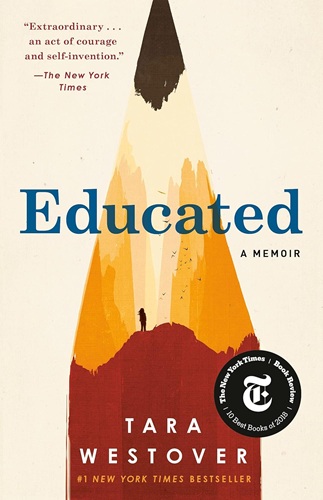
In Educated, Tara Westover tells a story about survival and eventually learning. The memoir follows a girl raised in the mountains of Idaho by deeply paranoid Mormon survivalists who reject public education, hospitals, and government authority. But the question that threads its way throughout the book is, “What happens when a child is taught that obedience matters more than truth?”
Westover grows up with six siblings on Buck’s Peak, cut off from much of mainstream society. Her father, Gene, is convinced the government is corrupt and that the apocalypse is coming. The children are not sent to school, lack birth certificates for years, and are taught to fear doctors, teachers, and institutions. Her paternal grandmother sees the danger immediately, arguing that the children should be educated instead of “roaming the mountains like savages.” But Gene’s authority dominates the family.
Despite these broad paranoid strokes, Westover doesn’t paint her parents as caricatures. Gene is reckless, controlling, and often frightening, but he is not a simple villain. His worldview shapes every part of the family’s existence. He stockpiles food and weapons for the end times, drives through dangerous storms despite previous near-fatal crashes, and forces his children into hazardous scrapyard work that repeatedly leaves them injured. Time and again, he proves himself more dangerous to the family than the outside world he fears so intensely.
Yet the tragedy of the book is that Gene’s beliefs also infect the family’s sense of reality. After horrific accidents, including Shawn’s motorcycle crash and Gene’s own severe burns, the family continually resists medical treatment, turning to herbal remedies instead.
Westover’s education starts at 17, when she first enters a classroom. But her seeds of rebellion start way before that. Tyler, her older brother, becomes the book’s quiet moral center. Unlike the others, he reads, listens to music, and longs for order and calm. When he leaves for college, it plants an idea in Tara’s mind that another life may exist beyond the mountain.
That idea slowly grows stronger as conditions at home worsen. The scrapyard scenes are some of the most stressful passages in the memoir because danger is constant and casual. Tara is nearly crushed by falling metal; Luke’s leg catches fire after gasoline ignites; Shawn suffers a traumatic brain injury after falling onto concrete. These moments are horrifying mainly because Gene always dismisses risk and refuses accountability.
The memoir turns darker when Tara’s older brother, Shawn, returns home. His violence toward Tara is difficult to understand, especially under her parents’ noses. He alternates between affection and brutality (as many abusers do), apologizing after assaults only to repeat them later. One moment he teaches Tara to ride horses; the next he is strangling her, dragging her by the hair, or shoving her head into a toilet. The abuse is even more disturbing because of her parents’ willingness to excuse or erase it.
What makes Educated stand out is that Westover demonstrates how difficult it is to trust your own memory after years of manipulation. Even as Tara begins succeeding academically, she still doubts herself constantly. When Charles, her first boyfriend, asks if she is angry that her parents denied her an education, she instinctively defends them. Her struggle seems two-fold: to escape home and to believe her own voice, her own experiences.
The turning point arrives when Tara realizes remaining loyal to her father and to herself is a contradiction and therefore impossible. She writes, “I would remain a child, in perpetuity, always, or I would lose him,” — a statement that perfectly captures the emotional cost of independence.
The second half of the book, following Tara’s journey through Brigham Young University, University of Cambridge, and eventually Harvard University, shows her intellect emerging from what one could say is her childhood wreckage.
Watching Tara teach herself algebra and trigonometry after never attending school becomes genuinely inspiring. Her academic success isn’t easy. She earns it through relentless effort and often sheer panic.
By the end of the book, Westover does not suddenly heal her family or rescue everyone she loves. Instead, she accepts the painful truth that becoming educated required losing the version of herself her family demanded she remain.
Her final reflection of comparing her 16-year-old self to her adult version highlights the theme of the book and why Westover’s title is so fitting.
“The decisions I made after that moment were not the ones she would have made. They were the choices of a changed person, a new self.
You could call this selfhood many things. Transformation. Metamorphosis. Falsity. Betrayal.
I call it an education.”
Buy the book on Amazon.
_________________________________________________________________