
April 30th, 2026
Good Mothers Don’t Say That: A Dark Comedy About Motherhood, Honesty, and the Things You’re Not Supposed to Admit by Fatin Zakouta is an unsettling and moving short story that uses dark comedy to expose the private contradictions of modern motherhood. What begins as an almost mischievous peek behind the curtain of polite parenting quickly turns into a study of how honesty, when encouraged, can end up becoming a performance.
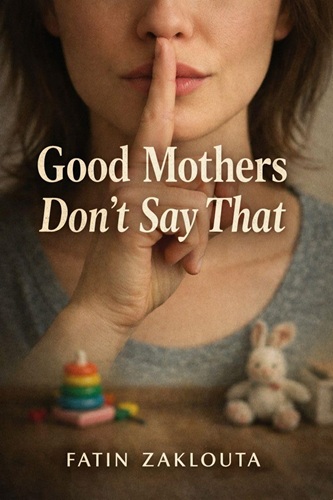
Zakouta does a good job of establishing the parenting culture in the first pages, like her observation about knowing another parent’s child’s allergies and passive-aggressive email style, but not her name. It’s funny because it’s true. Yet there’s something also a little tragic about it. That balance weaves its way throughout the entire story. The “unsayable” thoughts, like fantasizing about a minor accident just to rest in a hospital bed, free from snack requests, get delivered with a deadpan honesty that makes anyone who is a parent squirm (but also relate).
The core of the story is a secret meeting of exhausted parents who speak candidly about their frustrations or the scenarios they fantasize about but wouldn’t dare say out loud. Of course, this brings to mind an immediate question: do meetings like this exist, or are they purely fictional? Zakouta never answers that question.
By Chapter Three, when the group grows comfortable enough to admit fantasies of illness or escape, the meetings feel less like a gimmick and more like an emotional pressure valve that many readers will recognize.
However, there’s more to the story than just the confessions. As each meeting progresses, there’s a notable shift. Parents begin “retelling” their stories, not to share their experiences or their feelings, but to score points with the group. In other words, parents start editing their personal narratives, leaving out the irrelevant bits that won’t get the right reaction.
That tension climaxes in Chapter Five. A mother recounts letting her child cry alone for 40 minutes in order to let him “self-soothe.” The group collectively labels this as a success. But this praise for another parent is hard to read. For the reader, it almost feels like a form of abuse.
By Chapter Six, the narrator becomes aware of her own shift: that she’s no longer telling the truth, but reshaping it so it can get a better reaction, even thinking about how she will “retell” a story for the next meeting. The reactions are what she’s after now. And so, the meetings, while freeing at first, feel dishonest and performative.
Chapter Eight is the turning point. The narrator recounts a moment with her daughter, but then realizes that she has altered the story to, yet again, get a specific reaction from the listeners. “I had lied to belong,” she admits to herself later.
By the final chapters, the narrator stops attending the group meetings, and she finally accepts the messy, unresolved reality of parenting. “Nothing about it felt pure,” she says about raising her children. “Nothing about it needed to be.”
Buy the book on Amazon.
_________________________________________________________________